
In investing, as in life, experience is usually the best teacher. But it’s still easy to learn the wrong lessons.
Generals always fight the last war, relying on outdated strategies and past successes instead of adapting to new conditions and technologies. Investors tend to do the same thing, mistaking their foundational experiences for permanent laws of economics.
Investors starting out in the mid-1970s concluded that runaway inflation was an unyielding reality. Then it effectively disappeared for almost fifty years.
In the 1980s, it was obvious Japan was going to rule the world, right before the country experienced a crippling crash from which it never fully recovered.
The next decade saw the rise of the dot-com phenomenon, a “new normal” where traditional valuation metrics were dismissed as obsolete relics. Until they very much applied again, and even the best tech companies saw their stock prices spend a decade in the wilderness.
Then the world became obsessed with bricks and mortar, none more so than Australians. Decades of unbroken growth cultivated the view that not only does housing always go up, but that it doubles in value every seven years.
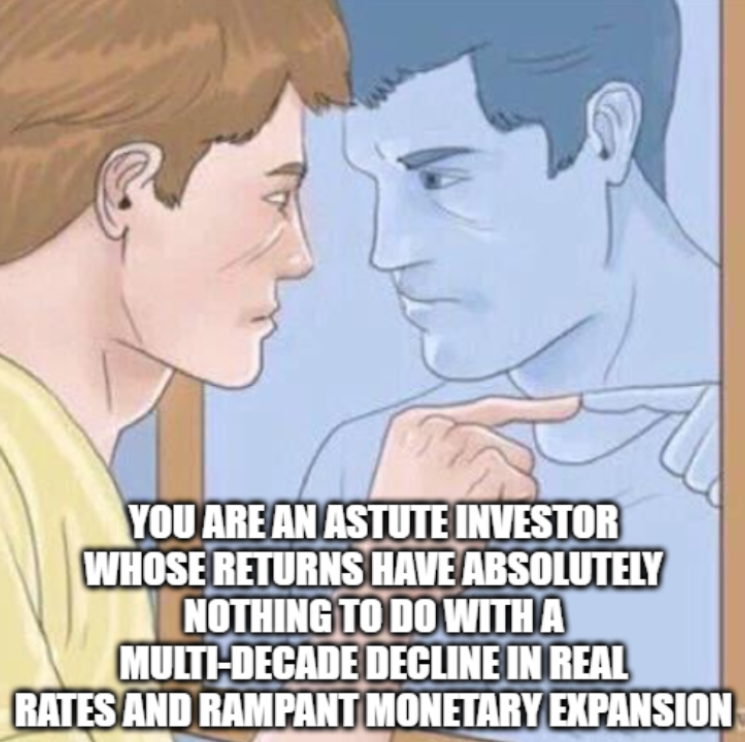
None of these ideas began as wild delusions. They began as undeniable truths supported by data and the direct experience of investors. Nor were they flash-in-the-pan fads that came and went over a summer, but a prolonged reality that defined the formative years of a generation.
An initial truth gradually hardens into consensus. Consensus then prices the future with increasing certainty, eventually disconnecting from reality altogether. Until, that is, the underlying reality shifts, the tide goes out, and most people are left standing naked on the beach.
That shift is where the damage is done: the kind well beyond what is suffered in a standard cyclical correction, where no reasonable amount of patience will make you whole. When a false permanence gets repriced, it tends to be violent and largely irreversible.
It’s also where you find the most extreme opportunity, at least if you’re not hard-wired to a world that no longer exists.
When a regime breaks, the people most fluent in the old map are often the last to update. But that same break creates a generational opening for anyone willing to notice that the landscape has changed.
Don’t mistake a decade or more of personal experience for eternal truth. Never allow the narrow slice of history that shaped your formative investing years to drive your financial philosophy without first weighing it against centuries of market history.
In other words, do not confuse the weather with the climate.
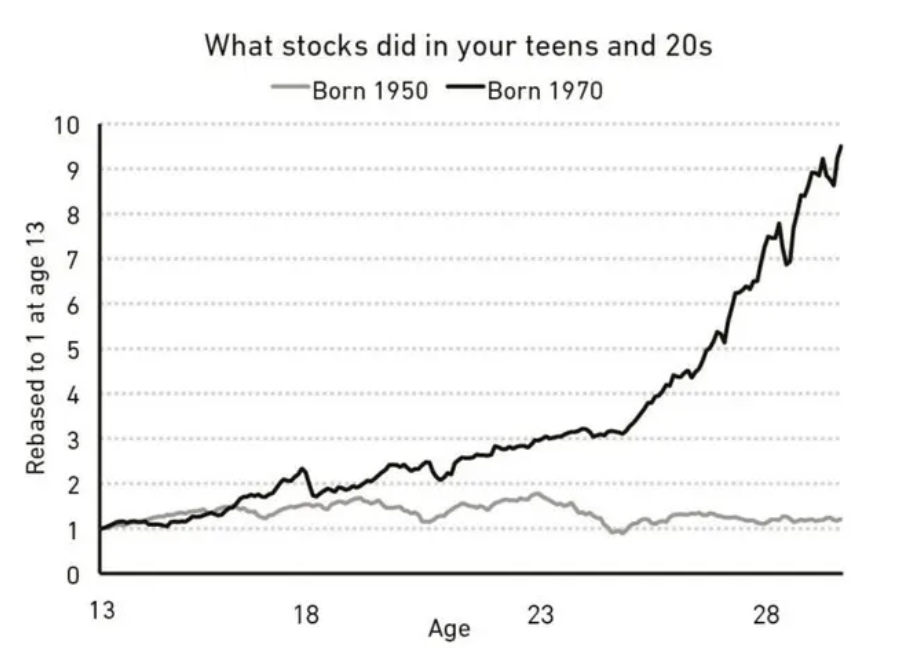
Those born in 1950 learnt that stocks were crappy investments. Their children learnt that markets only ever go up. Both experiences taught the exact wrong lessons, and it was those who rejected these shallow heuristics who made out like bandits.
Investing in a non-consensus way doesn’t guarantee success, but blindly following the crowd is almost always a bad idea.
The practical goal is not to predict when or how the current regime will break. Attempting to time the next shift is mostly an exercise in vanity, and being too early can be just as damaging as being too late.
Instead, the art is to notice how much of what you hold as absolute truth is actually just a memory of the era you started in, and one that simply isn’t evident over the broader arc of history.
True financial resilience is not built on predicting the future with exact precision. It is built on the quiet humility to leave room for the world to change, long before it forces you to do so. And when it does change, that same humility is what turns a regime break from a private catastrophe into a generational opportunity.
Strawman is Australia’s premier online investment club.
Members share research & recommendations on ASX-listed stocks by managing Virtual Portfolios and building Company Reports. By ranking content according to performance and community endorsement, Strawman provides accountable and peer-reviewed investment insights.
Disclaimer– Strawman is not a broker and you cannot purchase shares through the platform. All trades on Strawman use play money and are intended only as a tool to gain experience and have fun. No content on Strawman should be considered an inducement to buy or sell real world financial securities, and you should seek professional advice before making any investment decisions.
© 2026 Strawman Pty Ltd. All rights reserved.