There is something deeply triggering about billionaires. Especially those who hold obnoxious political views, post like manic teenagers, or simply come across as insufferable twats.
The popular narrative paints entrepreneurs as greedy hoarders, slicing off gigantic wedges of the economic pie while everyday workers are left with crumbs. In Australia, our national sport of cutting down tall poppies makes us particularly eager to view commercial success with suspicion, if not outright loathing.
But if you look at the actual data, the story flips on its head.
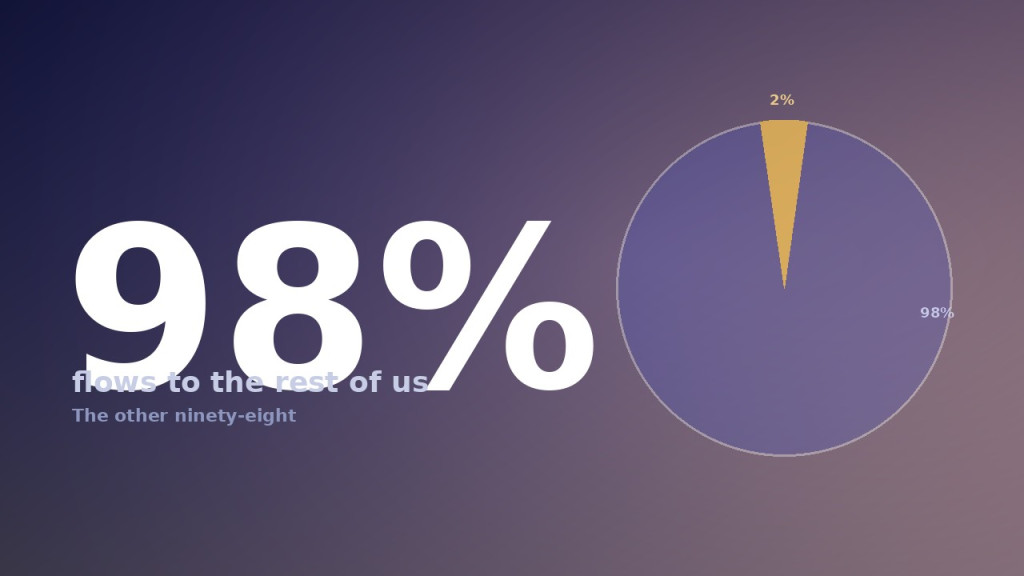
A couple of decades ago, Nobel laureate economist William Nordhaus set out to measure who actually benefits from technological progress and innovation, examining American enterprise over the preceding half-century. His conclusion was that innovators capture, on average, a measly 2% of the total social value they generate. In the fullness of time, the other 98% flows straight to the rest of us.
Think about what that means in practical terms. For every dollar of profit a founder manages to pocket, they dump roughly fifty dollars of value into the lap of the general public. This doesn't happen because billionaires are benevolent saints; it happens because of a brutal, relentless force called competition.
When some clever dick builds a better mousetrap, designs a faster food app, or engineers a cheaper solar panel, they might enjoy a brief window of fat profits. Then rivals copy the tricks, fix the flaws, and launch a price war. To survive, businesses are forced to slash prices or boost quality. The entrepreneur's outsized profit vanishes in a flash, but society's higher standard of living just keeps getting better.
Of course, there is the sleazy exception of crony capitalism. That's when corporate titans use political sway to erect regulatory moats around their turf. It's why thoroughly uninspired institutions like the ASX or AMP enjoy margins that would make a robber baron weep with envy.
Otherwise, market forces do a lot of quiet heavy lifting. Look at the pocket-sized supercomputers we carry, the vehicles we drive, and the fresh produce flown in from across the globe. The people who made this happen got rich, sure. But their fortunes are a tiny sliver of the immense, unmeasured abundance flooding our daily lives. Would you really throw all that away just to spite some boofhead on the BRW Rich List?
This isn't to say we owe billionaires our undying admiration. Only that there is no law against being a dickhead or harbouring bizarre political opinions. The world is stuffed with unpleasant people across every social stratum. But imagine a world where social popularity dictates wealth distribution. It sounds lovely until your own beliefs fall out of favour with the mob.
When we ignore economic reality and let popular but flawed thinking drive policy, we end up with excessive, ill-targeted taxes, suffocating regulation, and a mountain of red tape: friction that worsens the risk-reward calculation, diminishes competition, and undermines the very foundations of wealth creation.
Every dollar of lost opportunity for a would-be entrepreneur is a fifty-dollar loss for the rest of us. And if they fail, the rest of us bear virtually no cost from that stumble.
All upside, barely any downside. We should be doing everything possible to nurture business formation. Not through grants, licensing, or political favours, but simply by clearing the path and lowering barriers as far as prudently possible.
I'm not saying billionaires need more help either. I'm speaking more of the far larger cohort of small- and medium-business aspirants battling away in the trenches. Most will never know great riches. They push forward through risk and uncertainty for a modicum of self-reliance, delivering value in local niches that may be less glamorous than a reusable rocket, but still drive real benefit for their patrons. The local pharmacist, hairdresser, or mechanic. In aggregate, they are far more numerous and just as accretive to a society's true wealth.
So maybe we have the framing backwards. Entrepreneurs aren't suspects in need of a tighter leash. Most will fail on their own dime; the few who win drag the rest of us upward with them. Not just through the goods and services they provide directly, but through the jobs they create and the taxes they pay.
Hate the player if you want. But you gotta love the game.
Strawman is Australia’s premier online investment club.
Members share research & recommendations on ASX-listed stocks by managing Virtual Portfolios and building Company Reports. By ranking content according to performance and community endorsement, Strawman provides accountable and peer-reviewed investment insights.
Disclaimer– Strawman is not a broker and you cannot purchase shares through the platform. All trades on Strawman use play money and are intended only as a tool to gain experience and have fun. No content on Strawman should be considered an inducement to buy or sell real world financial securities, and you should seek professional advice before making any investment decisions.
© 2026 Strawman Pty Ltd. All rights reserved.